Hi All,
Former farm boy with childhood memories of visiting the local saddlery, cobbler and whip maker. I totally agree that workshops that do things I'm not familiar with are fascinating.
I most vividly remember the smell of the place, and it was still in the same wooden shop that opened in 1889, even back in the 1990s, operating daily as a sixth generation family business, with "gramps" sneaking in for a bit of cheeky leather work whenever his wife went shopping. I used to talk to his great-grandson who was roughly my age, and even
he wore a leather apron and was being shown the ropes.
In many ways, the shop's building itself was an anachronistic monument to it's time, because it still had a space to tie horses up at the front... although no one I know ever used that facility for the original purpose in my lifetime.
Inside, the workshop was an interesting place. A 19th century, wood-panelled workshop with rough-hewn logs as supports wherever the roof needed propping up, all sticking out of the original compacted dirt floor. It had seen some "modern ammenities" added over time, and had been renovated with a couple of small windows where the glass was thicker at the bottom than the top, distorting the view of the outside world. There were old saddles being repaired on custom stands that could have been crude headless life-sized rocking horses at some point, if they'd ever rocked. Around the room where the walls nearly met the ceiling, stock whips of all types, hanging in coiled rings on wooden pegs, all with little hand-written price tags dangling on their cotton strings. Of course, there was a cobbler's shoe anvil in the corner, and another mounted to the rear work bench, presumably a few others out of view... I was a kid and not tall enough to see over the timber counter.
The benches were still covered in tools that could have been a century old or more, although a few new handles, or shinier blades were seen here and there. Half-moon blades with well-worn handles, awls, and various stitching tools arranged through regular use more than anything else. That said, they did have a few electric buffing wheels and some sort of industrial revolution-aged and industrial-grade sewing machine that could probably be foot operated once again, should the survivors of any apocalypse require it. Nothing is destroying
that cast-iron monstrosity.
They might not have slaughtered the animals or tanned the hides there, but they probably did everything else you can imagine.
But back to shoes/boots:
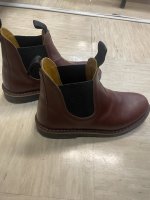
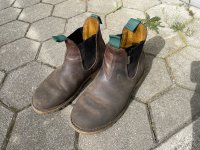
Here in Australia, we have the brand of boots called "R.M. Williams" who was started when a true Australian stockman learned leather craft and started a business making shoes back in the 1930s. They were really good and extremely well made and until the late 90s, which was when I bought my most recent pair for about $180 Australian (which is about $440 Australian today's money, and about $310USD at current exchange rates). A friend of mine have bought their boots recently, and found that unfortunately, the prices have increased significantly above inflation rates while the quality has dropped. They've basically become "dress boots" not "every day boots", despite the stockman/rural/outback cattle droving heritage.
Anyway, my friend bought a pair of R.M. Williams "Craftsman" boots for over $750 Australian ($530ish USD) back in August 2025, and they're aging like a fine....
milk... The boots may still be "hand made" but the materials are notably cheaper/thinner than my old pair. As a result, they're just
not built for daily use. Already, he has had to get some stitching redone, and the leather surface "reconditioned"... that's how we found out that the leather was thinner.... :~/
I'm all for buying local and supporting true craftsmen, but when investment companies take substantial ownership in an iconic company once a founder dies of extremely old age, things
rarely improve. So I'll be looking into some of the other boot brands you've all mentioned here once I'm ready to buy a new pair.
Anyway, I hope that is of interest/helps someone out there. If you love your old RM Williams boots as much as I do, I hope you can keep repairing them. However, if you're just joining the RM Williams bandwagon in 2020s and beyond... I'm less enthralled and recommend you do some research before you drop large wads of cash.
Speaking of weird tools for leather working, and that I've rambled on about the "Good ol' days" I came across a book on using
both CNCs and 3D printers to do leather crafting!
You can have a look at it here:
I actually thought it was an interesting read. Maybe they're also tools you might consider getting, or using for a traditional craft type like leather working. (Might as well use what you have, right?)
Just to add a little extra interest to the thread! Sorry if I was too verbose.
Harmo.