
You are using an out of date browser. It may not display this or other websites correctly.
You should upgrade or use an alternative browser.
You should upgrade or use an alternative browser.
Light Fixture Layout Collections
- Thread starter Platonic Solid
- Start date


menkarran
Member
Thanks for clearing this up for me.
I’m curious about the lumen output of led vs fluorescent tubes. I’m using an older layout drawing from this thread, the layout specs fluorescent tubes rated at 2800 lumens. The led tubes I’m looking at are rated at 2200 lumens each. As I understand the fluorescent tubes don’t direct all of their output in a usable direct (up and sideways). Where as the leds direct it all downward. Would these two tubes be comparable? Would the led be brighter? Or am I trying to compare apples and oranges
I need to wire up my new 20'x50' 15' garage for lighting asap and I'm trying to decide between 2' linear high bays and the standard 4' T8 tube fixtures.
High bays would be a much easier wiring job with less lights but am I going to have issues with shadows or will enough reflect off walls at that height? Walls & ceiling will be white drywall.
I used that visual interior tool but I don't know how to deal with shadows - it shows I could use only 6 very bright high bays for enough FCs, but I doubt that would be good in reality.
High bays would be a much easier wiring job with less lights but am I going to have issues with shadows or will enough reflect off walls at that height? Walls & ceiling will be white drywall.
I used that visual interior tool but I don't know how to deal with shadows - it shows I could use only 6 very bright high bays for enough FCs, but I doubt that would be good in reality.
I’m curious about the lumen output of led vs fluorescent tubes. I’m using an older layout drawing from this thread, the layout specs fluorescent tubes rated at 2800 lumens. The led tubes I’m looking at are rated at 2200 lumens each. As I understand the fluorescent tubes don’t direct all of their output in a usable direct (up and sideways). Where as the leds direct it all downward. Would these two tubes be comparable? Would the led be brighter? Or am I trying to compare apples and oranges
In this hypothetical, the LED will be significantly brighter.
Delivered lumens of a fluorescent T8 lamp is approximately 1700.
CD
Using highbays will be fine, but dont get super high powered ones. 12,000-ish will be fine. You might need more of them, but they'll cover OK. You get more ceiling and wall reflectance with the linear fixtures, but not as much output.
CD
CD
Using highbays will be fine, but dont get super high powered ones. 12,000-ish will be fine. You might need more of them, but they'll cover OK. You get more ceiling and wall reflectance with the linear fixtures, but not as much output.
CD
Thanks.
Do you think 8 10,0000-12,000 lumen fixtures laid out 2 rows wide by 4 long would be adequate coverage to reduce shadows? I'm not painting or anything, just general auto and wood work.
PALYDIN11
Well-known member
How do you save a photo of something you did on the visual interior tool?
Last edited:


Toomanytools?
Well-known member
Seems like you could benefit from another row 12 lights.
I saw that too. I ordered 12 total.Seems like you could benefit from another row 12 lights.
Miss the Pontiacs
Well-known member
Platonic Solid sent you a PM but your GJ box is full. PM when you get a chance.

aventino68
Well-known member

Obi-Wan
Well-known member
I used the Visualiser for a 40x80 garage with a 14ft ceiling. I used 52 FC, how does this relate to CRI? I should have CRI of 80? and is that about right with white walls, ceiling and light grey floor?
CRI refers to the quality of the light, not the quantity. A CRI of 100 is full-spectrum, so it has the same color as bright sunlight. A lower CRI (like 80) will often have an undesirable color cast to it--often greenish, in my experience.
As for the 52 FC in your shop, it depends entirely on what you plan to do in there. Different tasks require different amounts of light. Check out this list of recommended light levels on Engineering Toolbox:
https://www.engineeringtoolbox.com/light-level-rooms-d_708.html
You'll have to do a little math based on your ceiling height. I set my shop up for about 115 FC (measured at waist level), which is good for automechanic work. That gives me a little wiggle room for the lights to dim as they age.
To get that level with a 14' ceiling, I used one 4200-lumen fixture for every 5'x5' square of ceiling space. It's a very even, shadowless light, except when you're right up near the walls (which are bare OSB).
aventino68
Well-known member
Thanks for the explanation, it's a basic workshop just working on old cars. Before I try again with the software it shows over 120 light fittings for my 80x40x14. Can I use higher lumen LED lights wider spaced, say 8400 lumen lights instead per 50 sq/ft. And half or more the amount of light fittings I need to wire in? Though I get that the fewer lights the more shadows, if I dropped it to approx 60 fittings would i notice it? The doors are on the long wall so I'd like to mount the lights to the trusses, 90 degrees to what the software shows. Does that make any difference?CRI refers to the quality of the light, not the quantity. A CRI of 100 is full-spectrum, so it has the same color as bright sunlight. A lower CRI (like 80) will often have an undesirable color cast to it--often greenish, in my experience.
As for the 52 FC in your shop, it depends entirely on what you plan to do in there. Different tasks require different amounts of light. Check out this list of recommended light levels on Engineering Toolbox:
https://www.engineeringtoolbox.com/light-level-rooms-d_708.html
You'll have to do a little math based on your ceiling height. I set my shop up for about 115 FC (measured at waist level), which is good for automechanic work. That gives me a little wiggle room for the lights to dim as they age.
To get that level with a 14' ceiling, I used one 4200-lumen fixture for every 5'x5' square of ceiling space. It's a very even, shadowless light, except when you're right up near the walls (which are bare OSB).
The only 80x40 on this thread is back in 2015 and it sadly doesn't use LED lights in the planning.
Obi-Wan
Well-known member
Thanks for the explanation, it's a basic workshop just working on old cars.
I do a lot of automotive work, too. My eyes aren't getting any younger, and I really love the quantity & quality of light in my shop. I do still drag out a work light when I'm working between the car & wall, under the hood, or under the car, but otherwise the light is great.
When doing woodworking, the even spread of light is wonderful to have.
Before I try again with the software it shows over 120 light fittings for my 80x40x14. Can I use higher lumen LED lights wider spaced, say 8400 lumen lights instead per 50 sq/ft. And half or more the amount of light fittings I need to wire in? Though I get that the fewer lights the more shadows, if I dropped it to approx 60 fittings would i notice it? The doors are on the long wall so I'd like to mount the lights to the trusses, 90 degrees to what the software shows. Does that make any difference?
As you mentioned, reducing the number of fixtures to provide the same lumens will only create more shadows and hot spots. The light won't be spread quite as evenly. The design you posted above shows 24 fixtures. Where'd 120 come from?
Rotating your fixtures 90 degrees with respect to the software plan will also make sharper shadows because your lights will be in long strips.
Will you notice the difference? That depends on how picky you are, and whether you've ever experienced anything better. I'm a photographer, so I'm constantly aware of lighting conditions everywhere I go. That can be a curse sometimes.
However, if your ceiling consists of just open trusses with no structural support between them, then there's a huge advantage to simply running the lights & wires in parallel along the bottom of each truss, even if it means spacing them 8' apart. I'd probably do that if I were you. In my shop, there's an attic above the shop, so I have floor joists every 16" across my entire ceiling. I was able to put my fixtures and run my wires pretty much anywhere I wanted. Attached is a photo taken right after I first hooked up the lights.
Are your big doors overhead or sliders? If overhead, how often will you be trying to work while they're open? An open overhead door will block an awful lot of light. I'm not sure if you have the flexibility to position your lights around that, but it's something to consider.
The only 80x40 on this thread is back in 2015 and it sadly doesn't use LED lights in the planning.
LED vs fluorescent tube doesn't matter, except in the energy used & the cold weather start-up time. They'll cast the same light.
Speaking of energy used, pay attention to the current used by each fixture and how many separate lighting circuits you'll need to feed your entire ceiling. My 35 fixtures filled a single 15A circuit.
Another thing I did with my 35 fixtures was to split them up into 3 switches. One switch is a 3-way with illuminated switches at every door. (I *love* those illuminated switches!) That switch controls just 4 fixtures spaced evenly around the entire shop. I use that switch when I'm just running in to grab a tool or something and don't need to light everything like day.
A second switch (only by the main door) controls the remaining fixtures in the front half of my shop. A third switch (also only by the main door) controls the remaining fixtures in the back half of my shop.
The wall switches for my overhead garage door openers also have motion sensors on them that will turn on the small lights in the openers whenever something in the shop moves. I didn't request that, but it's been nice to have.
The ability to control the lighting like that has come in really handy on several occasions--not the least of which has been during several graduation parties when we were running a projected slide show at one end of the shop and needed it darker back there.
Attachments

Last edited:
aventino68
Well-known member
Obi-Wan, thanks for the reply. The 24 fixtures were because my FC was ridiculously low. Now that I go with 93 or 100 FC and around 4000 lumens per LED I get the setup below with 108 lights. I'm going to try to find a balance and use around 10000 to 18000 lumen lights and get down to 30 or 40 total. Aiming for 125 lumens /sq ft so around 360-400,000 lumens for whole shop and split shop into 4 areas for lighting control.
The individual lights for a quick trip into shop is a great idea. I'm still waiting on plan but roof trusses should end up close enough that I can run lights longways as you suggested is better.
Need to have a serious think about rest of siting of switches and I'm running a 20' x 20' mezannine in the back corner which has a man cave underneath it and will need its own lighting. I'm thinking the main doors won't be open at night often enough while I'm working so I'm ok with them occasionally blocking the light.
The individual lights for a quick trip into shop is a great idea. I'm still waiting on plan but roof trusses should end up close enough that I can run lights longways as you suggested is better.
Need to have a serious think about rest of siting of switches and I'm running a 20' x 20' mezannine in the back corner which has a man cave underneath it and will need its own lighting. I'm thinking the main doors won't be open at night often enough while I'm working so I'm ok with them occasionally blocking the light.
Attachments

TTMotorsports
Well-known member
My shop to get the 90 lumens required something like 24 fixtures. I used only 16 and it was way brighter than any shop I had seen before or ever had myself.
Sent from my SM-G965U using Tapatalk
Sent from my SM-G965U using Tapatalk
aventino68
Well-known member
What size is it and how high are the lights and what size are they please.My shop to get the 90 lumens required something like 24 fixtures. I used only 16 and it was way brighter than any shop I had seen before or ever had myself.
Sent from my SM-G965U using Tapatalk
TTMotorsports
Well-known member
My lights are 4ft leds. 23100 lumens each and the lights are at 14ft high roughly
Sent from my SM-G965U using Tapatalk
Sent from my SM-G965U using Tapatalk
aventino68
Well-known member
My lights are 4ft leds. 23100 lumens each and the lights are at 14ft high roughly
Sent from my SM-G965U using Tapatalk
So if 24 lights initial calculation got you the 90FC that would indicate that your shop is around 6160 sq ft.
TTMotorsports
Well-known member
Actually my lights are 19300 lumens or so and 4000 sq ft shop. Also I was close rto 100 lumens too
Sent from my SM-G965U using Tapatalk
Sent from my SM-G965U using Tapatalk
tadams72
Active member
Looking for lighting recommendations for shop we start on this spring. Will be used for car restoration/maintenance, rv storage, general hanging out etc. total dimensions are 42x54x16 with a 12x42x10 loft on the rear wall. No wall or ceiling coverings with concrete floor. Definitely want LEDs and was considering the ufo lights from Hyperlite though I would consider a quality American made product from reputable company if price isn’t too out of hand. Probably go three separate switches (one for each bay) for the main area.
Will need to do something different for above and below the loft area. Also looking for lighting outside lean-to for social gatherings. It’s 8x54x9 high.
Thanks
Travis
Will need to do something different for above and below the loft area. Also looking for lighting outside lean-to for social gatherings. It’s 8x54x9 high.
Thanks
Travis
Attachments

I can see that you're struggling with this. Let me try to help a little.Obi-Wan, thanks for the reply. The 24 fixtures were because my FC was ridiculously low. Now that I go with 93 or 100 FC and around 4000 lumens per LED I get the setup below with 108 lights. I'm going to try to find a balance and use around 10000 to 18000 lumen lights and get down to 30 or 40 total. Aiming for 125 lumens /sq ft so around 360-400,000 lumens for whole shop and split shop into 4 areas for lighting control.
The individual lights for a quick trip into shop is a great idea. I'm still waiting on plan but roof trusses should end up close enough that I can run lights longways as you suggested is better.
Need to have a serious think about rest of siting of switches and I'm running a 20' x 20' mezannine in the back corner which has a man cave underneath it and will need its own lighting. I'm thinking the main doors won't be open at night often enough while I'm working so I'm ok with them occasionally blocking the light.
First, the fixture that you're using is an 80/20 fixture that puts 20% of it's output directly upward. But you've hypothetically got them mounted on the ceiling, so the computer has eliminated 20% of the light from them.
At 14' you should be looking for a small highbay fixture that has output in the 12,000 to 18,000 lumen range. You are just barely high enough for them. Laid out properly, you wont have any issues with shadows or contrast.
Finally, discard the notion of lumens per square foot. It's a metric that has no meaning and will lead you down the wrong path. Just let the computer do it.
Good luck,
CD
I've manage to build most of my shop with help from this site. However I'm pulling my hair out with the lighting plan. I have a ton of 4bulb t8 troffers that have LED bulbs (4000k & 1800 lum) in them. I'm not sure how many I need to put up in my shop. 27x27 with 14' walls. I dismantled an old barn and used the wood for the walls (dark barn wood),used the old rusty galvanized metal roof for my flat ceiling at 14'. semi polished concrete floor. One site says 6 lights one say 12??? Should I split the difference at 9? Thanks in advance.
TTMotorsports
Well-known member
I would wire it up to run the more lights if needed but I'd do the less lights and add on if needed or where needed specifically.
Sent from my SM-G965U using Tapatalk
Sent from my SM-G965U using Tapatalk
Do you have pics? I have nearly the same size shop and trying to decide on ufo style or 4 x 2' fixtures.
Well I bought me some HYPERLITE 5000K LED UFO High Bay Lights 100W Coollight 14,000lm. Going to do 4 rows of 3 or maybe 3 rows of 4 isn't much difference between the two but with 4 rows I can split them up and only light 1/2 of the shop when needed.. and on a dimmer just hope these lasts.

Re: Suggested Fixture Layout 28' x 24' x 8'
My garage is close to this size...24.5' x 23' x 8', so I was thinking of going with one of these 3 plans, using LED wraps. Any insight on the lights here...?
https://www.amazon.com/dp/B07BGYMSFS/?tag=atomicindus08-20
Spec sheet is on the page; tried to upload but it's too big.
Help is appreciated. Thanks in advance.
Since this is a good representation of a typical household garage, here are 4 layouts including my recommendation and gtae07's plan.
(Click Images for larger view)
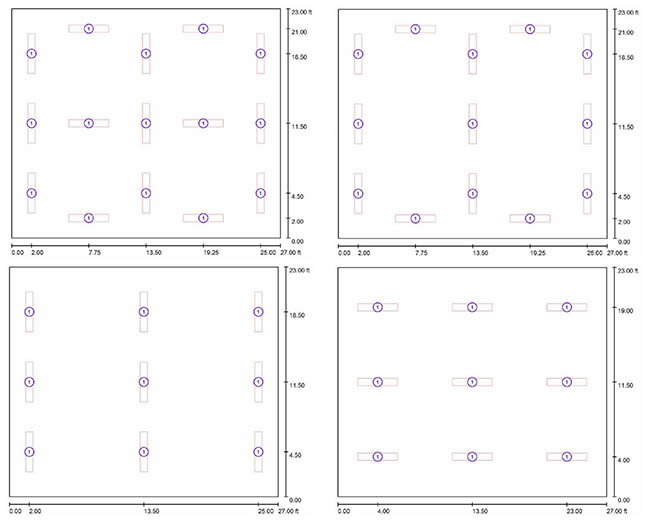
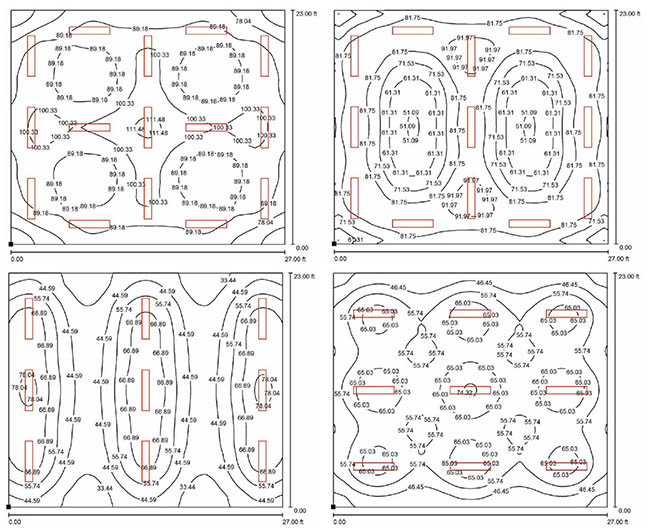
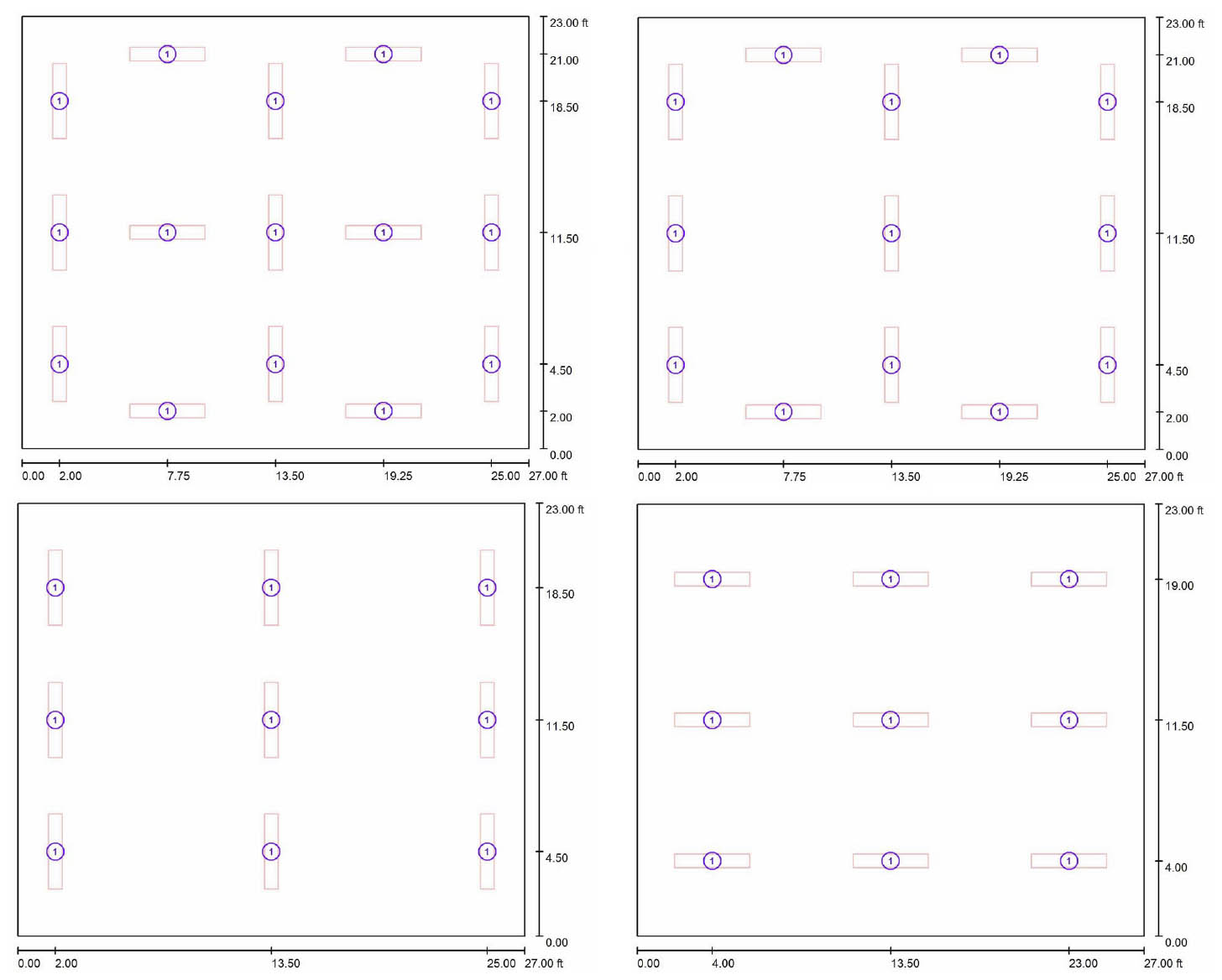
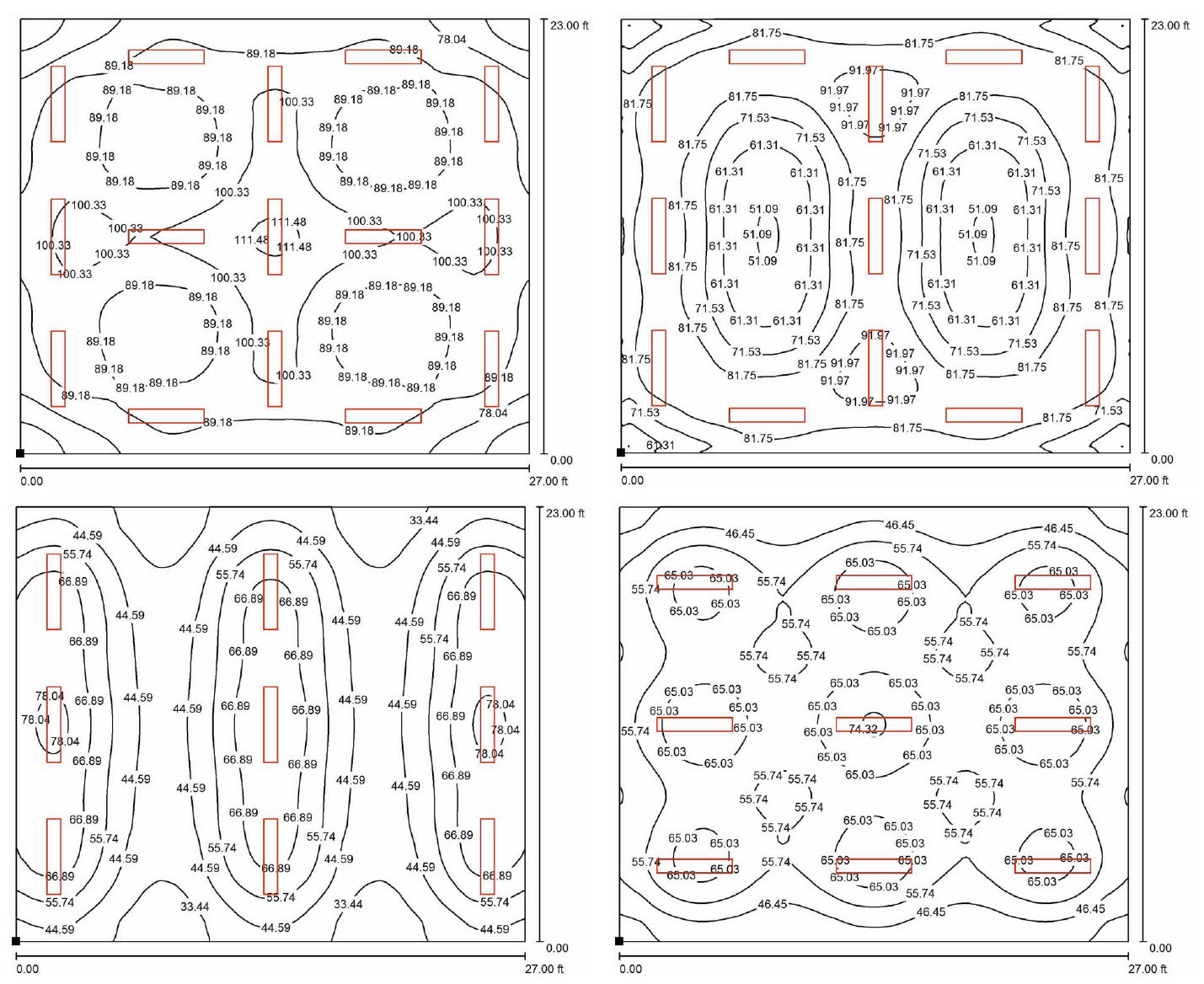
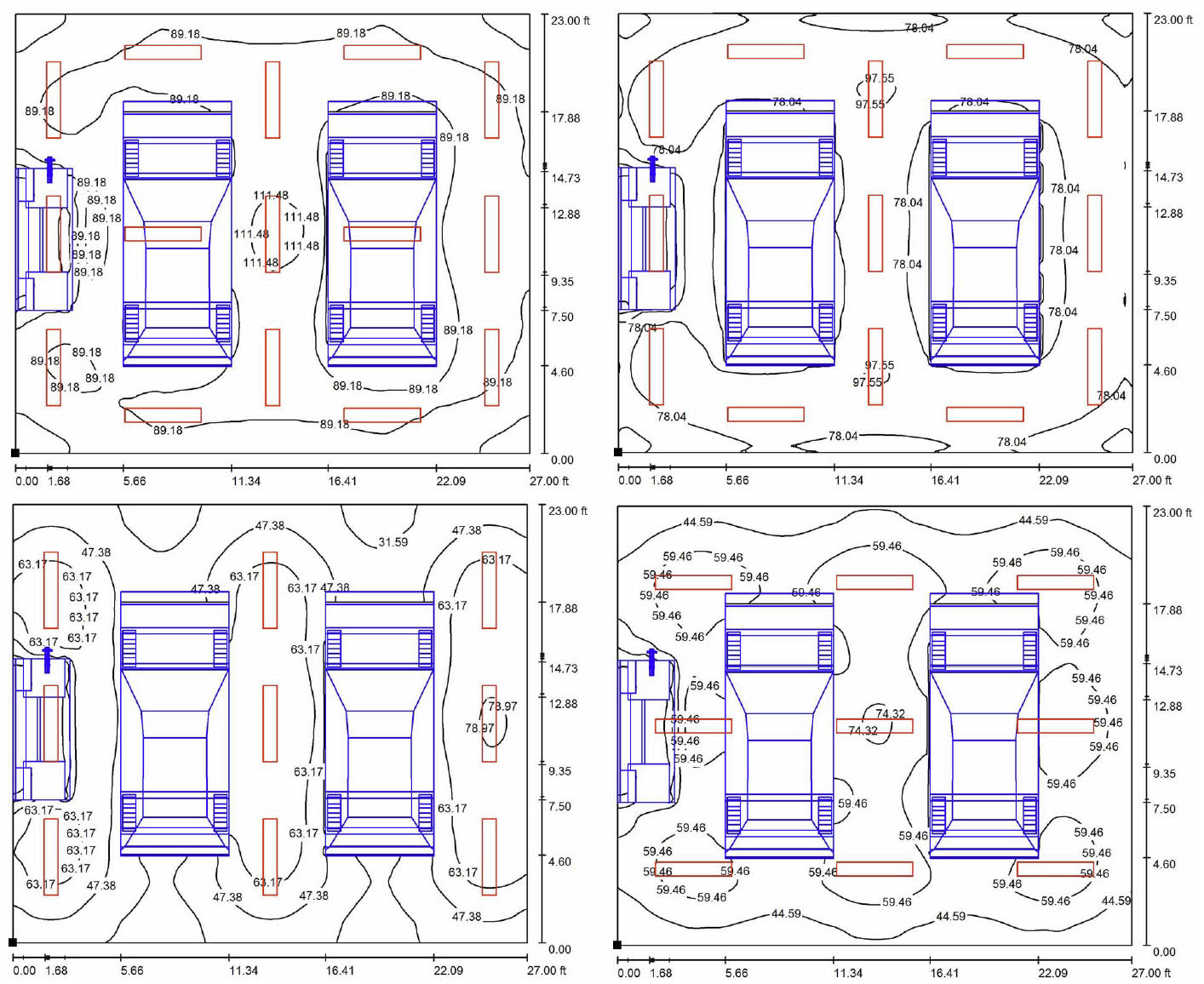
My garage is close to this size...24.5' x 23' x 8', so I was thinking of going with one of these 3 plans, using LED wraps. Any insight on the lights here...?
https://www.amazon.com/dp/B07BGYMSFS/?tag=atomicindus08-20
Spec sheet is on the page; tried to upload but it's too big.
Help is appreciated. Thanks in advance.
rnpatrick
Member
High Bay or 4' Strip?
Hi All - been digesting this thread and the Best Light Fixture Ever thread and installed DIALux evo in an attempt to get lights designed for my new garage.
I think the first question I need to figure out is whether to use the Best Ever 4' strip light or switch to a high bay fixture.
My garage is 40x60x13.5. White drywall, flat white ceiling. To get it bright enough to do car work (100 at the work plane) with the 4' strip, the Visual Tool is coming up with a LOT of fixtures - as in 42.
Is 13.5' high enough to use high-bay fixtures? Would those give me better quality light? Any rules of thumb for when to use one type of fixture vs. another?
Thanks in advance to those who have been down this road already and can help!
RP
Hi All - been digesting this thread and the Best Light Fixture Ever thread and installed DIALux evo in an attempt to get lights designed for my new garage.
I think the first question I need to figure out is whether to use the Best Ever 4' strip light or switch to a high bay fixture.
My garage is 40x60x13.5. White drywall, flat white ceiling. To get it bright enough to do car work (100 at the work plane) with the 4' strip, the Visual Tool is coming up with a LOT of fixtures - as in 42.
Is 13.5' high enough to use high-bay fixtures? Would those give me better quality light? Any rules of thumb for when to use one type of fixture vs. another?
Thanks in advance to those who have been down this road already and can help!
RP
Re: High Bay or 4' Strip?
RP, I have both types of fixtures. The rule of thumb that I've seen here is that 12' is the minimum for high bay fixtures.
The main thing I would say is to embrace the excess. It may seem like too many fixtures, but the result is well worth it. The lighting is one of the best choices I made in my build - just over 100 FC throughout the shop. I posted a lighting photo below.
https://www.garagejournal.com/forum/showpost.php?p=8788105&postcount=2474
Due to the higher ceiling in the center section, the lighting is just as even there as in the lean-tos.
Is 13.5' high enough to use high-bay fixtures? Would those give me better quality light? Any rules of thumb for when to use one type of fixture vs. another?
Thanks in advance to those who have been down this road already and can help!
RP
RP, I have both types of fixtures. The rule of thumb that I've seen here is that 12' is the minimum for high bay fixtures.
The main thing I would say is to embrace the excess. It may seem like too many fixtures, but the result is well worth it. The lighting is one of the best choices I made in my build - just over 100 FC throughout the shop. I posted a lighting photo below.
https://www.garagejournal.com/forum/showpost.php?p=8788105&postcount=2474
Due to the higher ceiling in the center section, the lighting is just as even there as in the lean-tos.
rnpatrick
Member
Re: High Bay or 4' Strip?
Hey OneOfEm - did a quick look and need to wait till after work to dig in more but that is good advice and appreciate your help - your shop looks great!
And Excess is my middle name - I'd rather turn off or dim a few extra fixtures than curse the darkness
RP, I have both types of fixtures. The rule of thumb that I've seen here is that 12' is the minimum for high bay fixtures.
The main thing I would say is to embrace the excess. It may seem like too many fixtures, but the result is well worth it. The lighting is one of the best choices I made in my build - just over 100 FC throughout the shop. I posted a lighting photo below.
https://www.garagejournal.com/forum/showpost.php?p=8788105&postcount=2474
Due to the higher ceiling in the center section, the lighting is just as even there as in the lean-tos.
Hey OneOfEm - did a quick look and need to wait till after work to dig in more but that is good advice and appreciate your help - your shop looks great!
And Excess is my middle name - I'd rather turn off or dim a few extra fixtures than curse the darkness
turtl631
Well-known member
I am planning a roughly 30 by 30 ft garage with 10 ft ceiling, half with attic trusses and half with scissor trusses and a lift. A few years ago on my last garage that had all 10-ft ceilings I used the 4-ft fixtures with dual LED bulbs in a standard platonic solid recommended layout outlining the vehicle bays and this worked out great. My question for my new setup is, should I go with the three bulb fixtures for the vaulted ceiling with scissor lift? Also, between the two bays is the interface between the addict and the vaulted ceiling. Should I put a few lights on the vaulted ceiling and on the 10-ft ceiling next to it in parallel arrangement?
jt1103
Member
Hey guys, I read through this and the Best Lighting Fixture post before buying 5 ShineRetrofit T8 fixtures and Greentek's bulbs for a total of 25,200 lumens, which I thought would be overkill for my 18x20x8 garage. However, the electrician put the first of the fixtures up today and the amount of light felt underwhelming.
Here is my current layout, did I overestimate the throw of this sort of fixture or should I stick to the plan and wait and see how things look with the other 4 fixtures installed?
Here is my current layout, did I overestimate the throw of this sort of fixture or should I stick to the plan and wait and see how things look with the other 4 fixtures installed?
Last edited:
78SC4X4
Well-known member
Hey guys, I read through this and the Best Lighting Fixture post before buying 5 ShineRetrofit T8 fixtures and Greentek's bulbs for a total of 25,200 lumens, which I thought would be overkill for my 18x20x8 garage. However, the electrician put the first of the fixtures up today and the amount of light felt underwhelming.
Here is my current layout, did I overestimate the throw of this sort of fixture or should I stick to the plan and wait and see how things look with the other 4 fixtures installed?
I think the short answer to your question is yes. Take a look at post #26 on this thread for an idea. You probably need twice that number.
jt1103
Member
Yeah, I got caught up in making sure I had enough lumens and lost sight of spreading it out evenly, thanks for the recommendation!
Sevillian
Active member
I'm working up a lighting plan and studying the stickies here. But I notice that neither the discussions nor the proposed plans specifically address lighting over workbench areas. Is that because if one achieves the around 93 FC of light, additional lighting is not needed? Or should I also be planning to add additional lights over the workbench? I'm talking about a 24" deep bench running along one wall of the garage.
aqr81
Well-known member
I need input from those in the lighting discussion that are knowledgeable or experienced with your own shop lighting. We are building a shop at my son’s home that will be used for auto repair, restoration and limited storage. It will be 34’ across front and 44’ deep. Walls will be 10’ top plate, scissors trusses with inside peak ceiling height at 12’ 9” in center and 11’ 1.5” at 7’ in from wall. There will be a 10’ X 8’ and 12’ X 8’ doors on the front. There will be a couple of window on sides and rear walls. The tool boxes, work benches and various equipment will be along the side and rear walls.
If visually divided into quarters, it will have a 2 post lift on left side front portion; rear area for engine assembly etc. There will also be a 4 post lift that will spend most of the time in the rear right portion, leaving the front right open for AC Service and other repairs not needing the 2 post lift. The 4 post would also be used for brakes, exhaust work etc. I’ve attached a lighting layout I sketched out based on Dadoffour Light Layout Post #157 In the Light Fixture Layout Collection and tweaked it a bit for my space and needs. This makes sense to me but I’m not that knowledgeable the lighting area; here is what I came up with…each of the 4 rows front to back [depth] would be (4) 8’ and (1) 4’ fixtures. Rows along front and back would be (1) 8’ and (1) 4’ fixture between each of the two main sections created with the 4 rows running front to back.
The lights I’m planning on using are as follows from Home Depot:
Lithonia Contractor Select Lithonia 8 ft. 160-Watt Equivalent Integrated LED White Multi-Volt Strip Light Fixture (73- Watt 9000 Lumens 4000K 80 CRI) Model #MNSL L96 2LL MVOLT 40K 80CRI $93.13 each (need 20)
Contractors Select Lithonia 4 ft. 64-Watt Equivalent Integrated LED White Multi-Volt Strip Light Fixture 35-Watt 4500 Lumens 4000K 80 CRI) Model # MNSL L48 2LL MVOLT 40K 80CRI M6 $40.38 (need 8)
Any input, thoughts, or suggestions would be very much appreciated.
If visually divided into quarters, it will have a 2 post lift on left side front portion; rear area for engine assembly etc. There will also be a 4 post lift that will spend most of the time in the rear right portion, leaving the front right open for AC Service and other repairs not needing the 2 post lift. The 4 post would also be used for brakes, exhaust work etc. I’ve attached a lighting layout I sketched out based on Dadoffour Light Layout Post #157 In the Light Fixture Layout Collection and tweaked it a bit for my space and needs. This makes sense to me but I’m not that knowledgeable the lighting area; here is what I came up with…each of the 4 rows front to back [depth] would be (4) 8’ and (1) 4’ fixtures. Rows along front and back would be (1) 8’ and (1) 4’ fixture between each of the two main sections created with the 4 rows running front to back.
The lights I’m planning on using are as follows from Home Depot:
Lithonia Contractor Select Lithonia 8 ft. 160-Watt Equivalent Integrated LED White Multi-Volt Strip Light Fixture (73- Watt 9000 Lumens 4000K 80 CRI) Model #MNSL L96 2LL MVOLT 40K 80CRI $93.13 each (need 20)
Contractors Select Lithonia 4 ft. 64-Watt Equivalent Integrated LED White Multi-Volt Strip Light Fixture 35-Watt 4500 Lumens 4000K 80 CRI) Model # MNSL L48 2LL MVOLT 40K 80CRI M6 $40.38 (need 8)
Any input, thoughts, or suggestions would be very much appreciated.
Attachments

CRI refers to the quality of the light, not the quantity. A CRI of 100 is full-spectrum, so it has the same color as bright sunlight. A lower CRI (like 80) will often have an undesirable color cast to it--often greenish, in my experience.
As for the 52 FC in your shop, it depends entirely on what you plan to do in there. Different tasks require different amounts of light. Check out this list of recommended light levels on Engineering Toolbox:
https://www.engineeringtoolbox.com/light-level-rooms-d_708.html
You'll have to do a little math based on your ceiling height. I set my shop up for about 115 FC (measured at waist level), which is good for automechanic work. That gives me a little wiggle room for the lights to dim as they age.
To get that level with a 14' ceiling, I used one 4200-lumen fixture for every 5'x5' square of ceiling space. It's a very even, shadowless light, except when you're right up near the walls (which are bare OSB).
Are you happy with ~115 FC for automotive work and general garage duties?
I would have thought I'd need much higher than that based on that link. But I put in 115FC in the software and came up with 16 4' 4000 lumen lithonia strips. That already seems overkill.
21x20 shop, 8' ceiling height. Concrete floor, white walls and ceiling.