To avoid these ads, REGISTER NOW!

Vintage Combination Square

Mintgrun

Well-known member
Joined
Oct 7, 2015
Messages
2,096
Location
Kingston, Wa.
I think the marks in the groove are from the drill bit walking while they were attempting to drill the hole.

They should have center-punched and drilled on the flat side.

EDIT-- (another vote for non-factory-hole)
 
To avoid these ads, REGISTER NOW!

INSP380

Well-known member
Joined
Dec 17, 2012
Messages
864
Location
Cleveland, Ohio
I think the marks in the groove are from the drill bit walking while they were attempting to drill the hole.

They should have center-punched and drilled on the flat side.

EDIT-- (another vote for non-factory-hole)
Could be, but the grooves were almost punched in, folded over so the slide wouldn’t drop. They were a lot more aggressive prior to me polishing it. Could have been the drill, but I doubt it.

It’s cheap no doubt, the made in the USA is it’s only saving grace right now.
 

RTM

Well-known member
Joined
May 13, 2019
Messages
12,987
Location
SF Bay Area
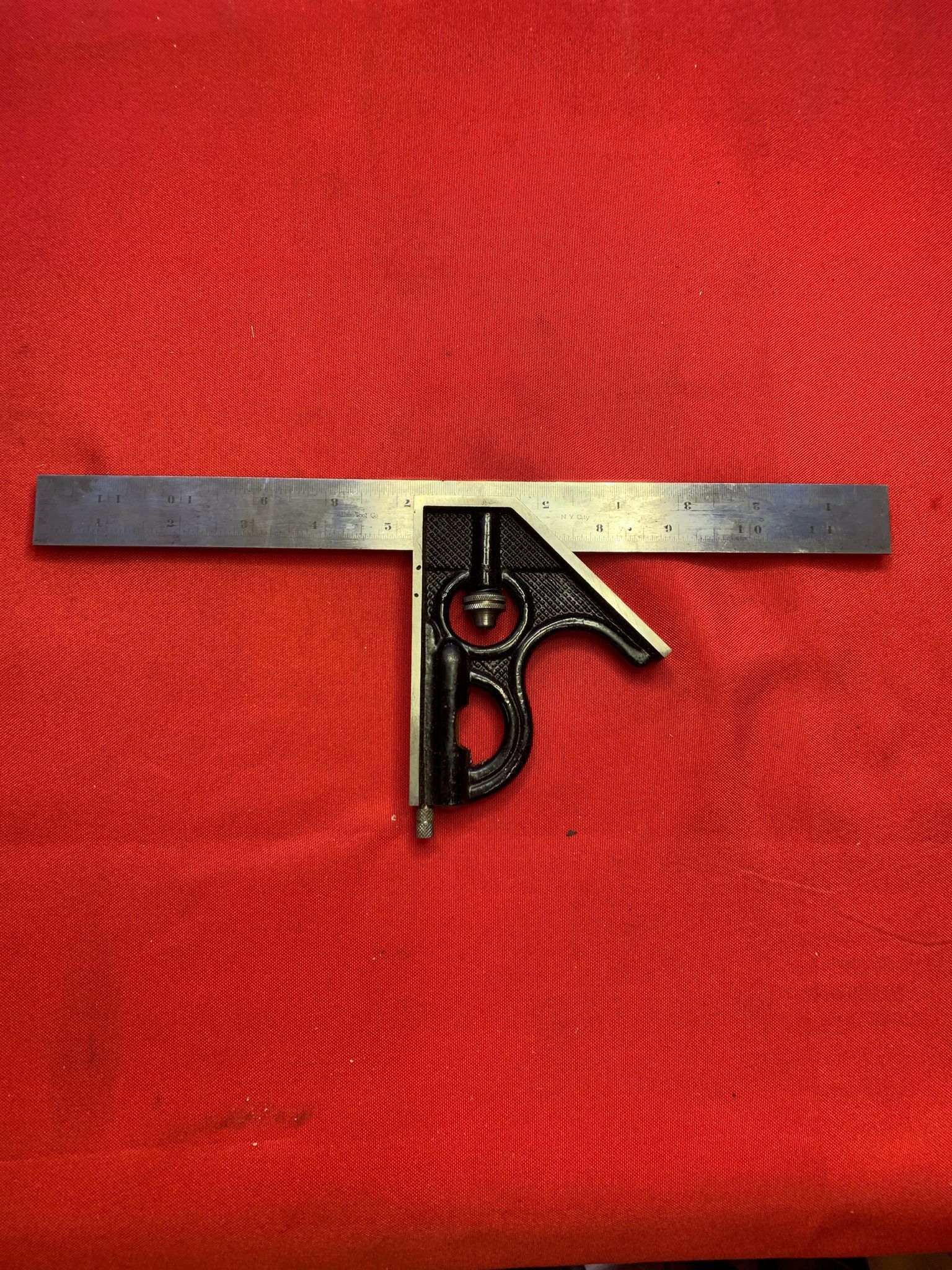
Here is an Atlas Tool Co NY combo square image I found online. Interesting that it has the grid pattern of the old Starrett, and the Union loop ish metal border. Also interesting in that it is in a Starrett museum R&D collection. Love the long handle on the scribe.


1762005021454.png
 

Eric Brown

ALLIANCE MEMBER
Joined
Jun 14, 2024
Messages
667
Here are a couple of Fulton 8" x 12" squares also marked Made in USA and BL. The BL indicates they were made for Sears by Sargent. The two squares are almost identical except that the black one also has a hang hole at the 1 1/4" area. Both were refinished. One with nickel plating and one black with white numbers. Both are blank on the back. An interesting thing is that the inside scales are in 1/8" spacing while the outside is in 1/12" spacing. Who uses 1/12"?

IMG_6130.JPG
 

leg17

Well-known member
Joined
Aug 11, 2011
Messages
1,365
Location
Kentucky

RTM

Well-known member
Joined
May 13, 2019
Messages
12,987
Location
SF Bay Area
n interesting thing is that the inside scales are in 1/8" spacing while the outside is in 1/12" spacing. Who uses 1/12
I know it’s useful for drafting work, 1”=1’, so maybe scaling drawings to the real world

Looking in a 1920s Stanley catalog May give the right answer
Determining board feet.
1762020647111.png
 

Beerhippie

Well-known member
Joined
Oct 13, 2023
Messages
9,490
Location
Far NE Oregon
Now I know:

54895130785_e537cc0b04_o.jpg

My old steel square. Marked only USA. Marked in sixteenths on the other side. Twice the thickness of my newer one.

I need to actually read my Book of the Steel Square.
 

Beerhippie

Well-known member
Joined
Oct 13, 2023
Messages
9,490
Location
Far NE Oregon
Rafter table is on the other side. This side is marked in 1/12 ft. on the outer side.

Come to think of it, as roof angle is measured in x/12, maybe....

Like I said, might be a good time to actually read that Essential Guide to the Steel Square I bought a year ago.
 
  • Like
Reactions: RTM

ararat

Well-known member
Joined
Dec 27, 2018
Messages
575
Location
Ararat NC
Here are a couple of Fulton 8" x 12" squares also marked Made in USA and BL. The BL indicates they were made for Sears by Sargent. The two squares are almost identical except that the black one also has a hang hole at the 1 1/4" area. Both were refinished. One with nickel plating and one black with white numbers. Both are blank on the back. An interesting thing is that the inside scales are in 1/8" spacing while the outside is in 1/12" spacing. Who uses 1/12"?

IMG_6130.JPG
Looks good. How did you refinish the black and white one?
 

Eric Brown

ALLIANCE MEMBER
Joined
Jun 14, 2024
Messages
667
Looks good. How did you refinish the black and white one
I used a gun blue first. Got several from Brownells a few years ago. My first attempt was the OXPHO-Blue on the smooth backside. It didn't work. Probably because the square is not tool or gun steel but a softer steel. Cleaned that off and used Formula 44/40. It worked better, but still had issues. Cleaned it off and washed the square with denatured alcohol. That worked. I was hoping the gun blue would work because if I used a paint it would fill the lines and numbers more. For the white I used a wax-like lacquer stick. Rub it in and wipe it off. Finally, I sprayed it with a clear lacquer.
 

Eric Brown

ALLIANCE MEMBER
Joined
Jun 14, 2024
Messages
667
Here is an interesting Fulton square made in Germany. It is similar to the P.L. Fox patent of Nov. 24, 1885 (331047) which was improved by three patents from R.A. Breul, Aug. 23, 1904 (768324), Apr. 12, 1921 (1374815 and 1374816). These patents all used stamped steel components and all had fixed beams. This Fulton one though has a movable beam. On the front side there are degree markings at 15, 25, 35, 45, 55, 65. There are also four square holes. Measuring from the one closest to the point, the other holes are at 6", 7" and 8". The back side has a rule 10" long. I did find a catalog picture of the Fox design in the 1933 Spiegel Brothers catalog, page 34. I did not see this Fulton square in the United Hardware & Tool catalog. Perhaps it was sold by Sears?

Fulton Fox like square 1.jpg


Fulton Fox like square 3.jpg

Fulton Fox like square 4.jpg

Spiegel Brothers Fox Square 1933 catalog pg 34.jpeg
 

Attachments

  • Spiegel Bros Corp 1933 Catalog 20.pdf
    20.3 MB · Views: 3

crguy

Well-known member
Joined
Jan 24, 2016
Messages
2,631
Location
SW Washington
Here is an interesting Fulton square made in Germany. It is similar to the P.L. Fox patent of Nov. 24, 1885 (331047) which was improved by three patents from R.A. Breul, Aug. 23, 1904 (768324), Apr. 12, 1921 (1374815 and 1374816). These patents all used stamped steel components and all had fixed beams. This Fulton one though has a movable beam. On the front side there are degree markings at 15, 25, 35, 45, 55, 65. There are also four square holes. Measuring from the one closest to the point, the other holes are at 6", 7" and 8". The back side has a rule 10" long. I did find a catalog picture of the Fox design in the 1933 Spiegel Brothers catalog, page 34. I did not see this Fulton square in the United Hardware & Tool catalog. Perhaps it was sold by Sears?

Fulton Fox like square 1.jpg


Fulton Fox like square 3.jpg

Fulton Fox like square 4.jpg

Spiegel Brothers Fox Square 1933 catalog pg 34.jpeg
Never heard of any of the Sears Fulton tools being made in Germany?
 

MisterEd

Well-known member
Joined
Oct 3, 2019
Messages
734
Location
Florida
A SigO find, of course. Center Finder with no name that we can find.
 

Attachments

  • 1Center-33.jpg
    1Center-33.jpg
    179.7 KB · Views: 17
  • 2Center-05.jpg
    2Center-05.jpg
    160.7 KB · Views: 18
  • 3Center-09.jpg
    3Center-09.jpg
    128 KB · Views: 17
  • 4Center-13.jpg
    4Center-13.jpg
    168.5 KB · Views: 16
  • 5Center-49.jpg
    5Center-49.jpg
    122.5 KB · Views: 13
To avoid these ads, REGISTER NOW!

Mintgrun

Well-known member
Joined
Oct 7, 2015
Messages
2,096
Location
Kingston, Wa.
I'm not sure the bottom example was made by Starrett, based on the shorter nut.

Here's an excerpt from post # 43.

I think the shorter Starrett-style nuts may be Sawyer tools, based on this catalog entry from 1905.

1709999811886.png


( Borrowed 'for education purposes' from here -- https://archive.org/details/sawyer-tool-mfg-co-catalog-h/page/20/mode/2up ).
 

AntiqueBen

Well-known member
Joined
Aug 4, 2021
Messages
1,436
I found a Bates Mfg Co combination square today for $3 (pics below). I should have taken a before pic, but I forgot. It was so rusted, I had no idea who the mfg was. The reason I bought it was because it still had its original scribe, which is always missing. I knew it was old & I was surprised to see Bates Mfg Co. I was expecting to see Stanley or another common brand. I'm not really familiar with Bates. I believe they made these squares in the 1910's. Anyone know anything about Bates squares & are they common?
 

Attachments

  • IMG_20260218_165231222.jpg
    IMG_20260218_165231222.jpg
    885.3 KB · Views: 13
  • IMG_20260218_165308106.jpg
    IMG_20260218_165308106.jpg
    829.2 KB · Views: 12
  • IMG_20260218_165244778.jpg
    IMG_20260218_165244778.jpg
    976.3 KB · Views: 11
  • IMG_20260218_165253991.jpg
    IMG_20260218_165253991.jpg
    735.9 KB · Views: 10
  • IMG_20260218_165335721.jpg
    IMG_20260218_165335721.jpg
    721 KB · Views: 9

AntiqueBen

Well-known member
Joined
Aug 4, 2021
Messages
1,436
I think that is a Starrett square with a BATES MFG rule. Starrett typically uses a thick rule, how's the fit?
The fit is perfect. I took everything apart & cleaned it. The fit is nice & tight. I don't think it's Starrett. I pulled one of my Starrett's out & the Bates rule is definitely thinner (pic below). I tried to put my Starrett rule in & it won't fit, to thick.
 

Attachments

  • Screenshot_20260218-173555.png.jpg
    Screenshot_20260218-173555.png.jpg
    347.4 KB · Views: 10

AntiqueBen

Well-known member
Joined
Aug 4, 2021
Messages
1,436
Google isn't much help. Check out the screenshot below. Google Books isn't much help either?
 

Attachments

  • Screenshot_20260218-175506.png.jpg
    Screenshot_20260218-175506.png.jpg
    277.6 KB · Views: 9

Mintgrun

Well-known member
Joined
Oct 7, 2015
Messages
2,096
Location
Kingston, Wa.
If that's a Bates square, they must have copied Starrett's design, right down to the nut.

I copied this from a Worthpoint page. Unfortunately, it doesn't have a photo of the square.


"Vintage Bates Mfg. Co 12" Combo Square Tough Find is a very unusual find, a Bates Mfg. Co 12" Combo square in good + condition, no issues at all aside from light pitting on one end of rule on one side. Very good aside from that. offers this brief history on this company, which was not around for too long.... " Founded as the Union Caliper Company in 1908, the business had been organized by Emory E. Ellis at Fitchburg, Massachusetts, for the purpose of making calipers and dividers for machinists. In 1911, the Union Caliper Company acquired the Indiana-based Hill Standard Tool Company and was moved to a larger site in Orange , Massachusetts. The combined operations occupied four times the floor space that had been available in the old location, and the purchase of Hill Standard Tool added thickness gages, tapes, and feeler gages to the lineup. A second operation, the Bates Manufacturing Company, a producer of steel rules, combination squares and hacksaw frames located in Fitchburg, was sold to Union Caliper Company on Nov. 21, 1913, for $5,000. John Clayton Bates , the founder of Bates Manufacturing , continued to supervise the operation after the buyout. In 1915, J.C. Bates moved to Orange to become manager of the Union Caliper Company; the measuring tool and hacksaw operations moved with him. With the operation making center punches, dividers, machine vises, hack saws, measuring tools, nail sets, lathe and planer accessories and add-ons for automatic screw machines, the company's original name no longer reflected its product line. In 1916, Emory E. Ellis and the directors of the Union Caliper Company changed the name of the business to the Union Tool Company. When Ellis died at age fifty-four on November 11, 1924, he left behind a growing company that was doing nicely. (By 1930, the Union tool Company was capitalized at $400,000 and had one hundred employees on payroll.) J.C Bates continued as the firm's manager. With Bates at the helm, measuring tools became increasingly important part of the Union Tool operation, and t is evidence that the company was supplying combination squares to Millers Falls well before the 1957 buyout. John Clayton Bates died on November 15, 1956—a year before the Millers Falls Company acquired Union Tool. "
 

AntiqueBen

Well-known member
Joined
Aug 4, 2021
Messages
1,436
If that's a Bates square, they must have copied Starrett's design, right down to the nut.

I copied this from a Worthpoint page. Unfortunately, it doesn't have a photo of the square.


"Vintage Bates Mfg. Co 12" Combo Square Tough Find is a very unusual find, a Bates Mfg. Co 12" Combo square in good + condition, no issues at all aside from light pitting on one end of rule on one side. Very good aside from that. offers this brief history on this company, which was not around for too long.... " Founded as the Union Caliper Company in 1908, the business had been organized by Emory E. Ellis at Fitchburg, Massachusetts, for the purpose of making calipers and dividers for machinists. In 1911, the Union Caliper Company acquired the Indiana-based Hill Standard Tool Company and was moved to a larger site in Orange , Massachusetts. The combined operations occupied four times the floor space that had been available in the old location, and the purchase of Hill Standard Tool added thickness gages, tapes, and feeler gages to the lineup. A second operation, the Bates Manufacturing Company, a producer of steel rules, combination squares and hacksaw frames located in Fitchburg, was sold to Union Caliper Company on Nov. 21, 1913, for $5,000. John Clayton Bates , the founder of Bates Manufacturing , continued to supervise the operation after the buyout. In 1915, J.C. Bates moved to Orange to become manager of the Union Caliper Company; the measuring tool and hacksaw operations moved with him. With the operation making center punches, dividers, machine vises, hack saws, measuring tools, nail sets, lathe and planer accessories and add-ons for automatic screw machines, the company's original name no longer reflected its product line. In 1916, Emory E. Ellis and the directors of the Union Caliper Company changed the name of the business to the Union Tool Company. When Ellis died at age fifty-four on November 11, 1924, he left behind a growing company that was doing nicely. (By 1930, the Union tool Company was capitalized at $400,000 and had one hundred employees on payroll.) J.C Bates continued as the firm's manager. With Bates at the helm, measuring tools became increasingly important part of the Union Tool operation, and t is evidence that the company was supplying combination squares to Millers Falls well before the 1957 buyout. John Clayton Bates died on November 15, 1956—a year before the Millers Falls Company acquired Union Tool. "
Good find. That's a cool history. Too bad there wasn't a pic. Seems the Bates marked square was short lived.
 

AntiqueBen

Well-known member
Joined
Aug 4, 2021
Messages
1,436
The scribe on this 12" Bates square is a giant compared to others I've seen. I pulled the scribe out of my big 18" Starrett & set it next to the Bates scribe. The Bates scribe is literally twice the size of the Starrett.
 

Attachments

  • IMG_20260218_190303620.jpg
    IMG_20260218_190303620.jpg
    1 MB · Views: 23

RTM

Well-known member
Joined
May 13, 2019
Messages
12,987
Location
SF Bay Area
Here is some info from DAT

There is no connection between this auger/bit maker and a Bates Mfg. Co. that made machinist tools in Orange 1913-27

DAT (directory of American toolmakers, pre 1900)

This obviously disagrees with @Mintgrun s post above, but I doubt his source is AI generated, but I could be wrong. As it's outside DAT's pervue, I don't know if it will ever get fixed. I will see if I can find period literature to verify

There are known errors in DAT, but I have not found anything on Bates Usually it's someone bringing up an external data point that we can verify thru period current literature.
 

AntiqueBen

Well-known member
Joined
Aug 4, 2021
Messages
1,436
Here is some info from DAT

There is no connection between this auger/bit maker and a Bates Mfg. Co. that made machinist tools in Orange 1913-27

DAT (directory of American toolmakers, pre 1900)

This obviously disagrees with @Mintgrun s post above, but I doubt his source is AI generated, but I could be wrong. As it's outside DAT's pervue, I don't know if it will ever get fixed. I will see if I can find period literature to verify

There are known errors in DAT, but I have not found anything on Bates Usually it's someone bringing up an external data point that we can verify thru period current literature.
But we know that Union Caliper Co bought Bates Mfg Co in Orange Mass in 1913 & by 1915 the combined entity became Union Tool Co. So, anything marked Bates would have to be prior to 1915-16.
 

Mintgrun

Well-known member
Joined
Oct 7, 2015
Messages
2,096
Location
Kingston, Wa.
Starrett made a variety of squares (obviously). I measured a few Starrett rules and most are .090" thick, but one is a fat .092".

The Starrett squares I have all use those big fat ball-end scribes.

The problem with identifying these tools is that the bits and pieces often get mix-matched over the years and they don't often mark the logo on the square itself. I do have Starrett squares that are marked, but even more of them that are not.

That said, I assume the unmarked examples are Starrett based on the castings being the same and the thumb nut design.
 

AntiqueBen

Well-known member
Joined
Aug 4, 2021
Messages
1,436
Starrett made a variety of squares (obviously). I measured a few Starrett rules and most are .090" thick, but one is a fat .092".

The Starrett squares I have all use those big fat ball-end scribes.

The problem with identifying these tools is that the bits and pieces often get mix-matched over the years and they don't often mark the logo on the square itself. I do have Starrett squares that are marked, but even more of them that are not.

That said, I assume the unmarked examples are Starrett based on the castings being the same and the thumb nut design.
The thumb nut design you point out I believe was a popular design used by other manufacturers as well. I suppose until some specific information or pics are found on Bates, there is no way to say for certain.
 

AntiqueBen

Well-known member
Joined
Aug 4, 2021
Messages
1,436
I found a good reference. Below is a pic of the Bates info.

Old tools Measuring Devices, Makers, Markers and Merchandisers of Instruments, Gauges, Rules, Squares & Tape Measures https://share.google/dSNfWces65rgqfAiy
 

Attachments

  • Screenshot_20260218-202011.png.jpg
    Screenshot_20260218-202011.png.jpg
    86.6 KB · Views: 17

Mintgrun

Well-known member
Joined
Oct 7, 2015
Messages
2,096
Location
Kingston, Wa.
You can see photos of other smaller Bates squares on ePay. They have that 'checkered' looking casting too.
1771468417709.png
Sawyer squares look a lot like the Starrett style, with similar checkering cast into them. I thought one I have was a Starrett tool, but was confused by the round opening, until I found them in a catalog. Here's the post I made about that one.


1771468507276.png

(probably just adding more confusion)
Tom
 

MAD

Well-known member
Joined
Jan 27, 2007
Messages
2,700
Location
Western MA

d42jeep

Well-known member
Joined
Oct 22, 2014
Messages
16,441
Location
Northern California
Starrett made a variety of squares (obviously). I measured a few Starrett rules and most are .090" thick, but one is a fat .092".

The Starrett squares I have all use those big fat ball-end scribes.

The problem with identifying these tools is that the bits and pieces often get mix-matched over the years and they don't often mark the logo on the square itself. I do have Starrett squares that are marked, but even more of them that are not.

That said, I assume the unmarked examples are Starrett based on the castings being the same and the thumb nut design.
Look at the size of the scribe handles in this 1882 ad for Starrett squares. I have some Starrett scribes with large handles as well. The nuts look shorter back then too.IMG_6774.jpeg
-Don
 
Last edited:
To avoid these ads, REGISTER NOW!
Top Bottom